Industries · Brand & creative sites

Brand website development with scroll animation

Online, many service businesses look the same: stock photos and a phone number. Brand website development is how a team shows what sets it apart — its work, its order, its way of doing things — and turns a visit into a request.

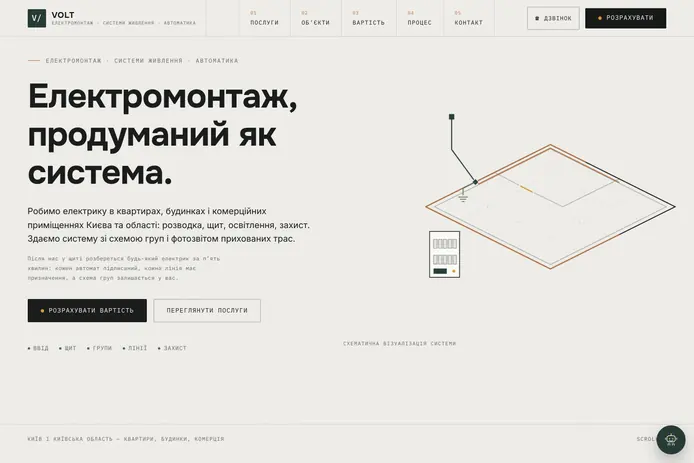
For VOLT, an electrical installation team, we made the work itself the visual: a Living Circuit, an axonometric plan of a room whose layers — routes, panel, lighting, sockets, grounding — draw themselves as you scroll. Eight scenes lead a visitor from what the team does to a quick estimate and a request with photos attached.

Motion is there to explain, not to decorate: it respects reduced-motion settings, and the site works without it. Fixed price, contract, payment by stage.

Case
VOLTbrand site / creative dev / 2026
Built
  • Creative direction
  • Scroll-driven animation
  • Service pages
  • Request flow with uploads
  • Lead API
Format
AI + DEV
Price
Fixed after scoping, paid by stage

Problems

Why most service sites don’t sell

  • Every competitor looks the same

    Stock photos and generic promises make a capable team indistinguishable from the rest of the search results.

  • Competence is hard to show

    A team that plans before it drills has no easy way to prove it on a page — especially without inventing projects or prices it cannot stand behind yet.

  • Animation that gets in the way

    Motion that slows the page, ignores reduced-motion settings or hides the text from search does more harm than good.

  • Requests that lose their details

    A bare contact form drops the photos and the context a quote needs, and wiring it to a CRM later means rebuilding it.

What we build

What we build for brands

  • Creative direction

    A visual idea taken from your own work rather than a stock library — VOLT’s circuit is the brand.

  • Scroll-driven animation

    Scenes that build as the visitor scrolls, respecting reduced-motion settings, with the site fully usable without them.

  • Service pages

    One page per service, written for the questions people search for and built to rank.

  • Process page

    How the work is done, step by step — the part that builds trust before the first call.

  • Request flow with uploads

    A quick estimate and a full request form with photos attached, sent through a lead API.

  • Ready for your CRM

    Requests go through one adapter, so connecting a CRM later means replacing one file, not rebuilding the site.

Case

How we built it for VOLT

A living circuit for an electrical installation team

VOLT is the site of an electrical installation team: wiring, panels, lighting, power and preparation for solar. The team needed to show competence and order — that they plan before they drill — without inventing projects or prices they could not stand behind yet.

The work itself became the visual: the circuit is the brand, and every section lights its own layer. Thirteen service pages, a process page and a full request form complete it; requests go through one adapter, so a CRM can be connected later by replacing one file.

Three formats

Choose how we build it

The format decides who writes the code and how much engineering review goes into it — and with that, the price and the pace.

  • AI / build

    AI Build

    Fastest path · prototypes & internal tools

    AI generates the structure and most of the implementation. Engineers review integrations and the release. The lowest cost, for prototypes, internal tools and MVPs that test an idea.

  • AI / engOur pick here

    AI + DEV

    Recommended for most MVPs

    AI builds the scaffolding and the obvious parts. Engineers own the architecture, critical logic, integrations and full QA. Balanced pace and review, for customer-facing MVPs and B2B products.

  • full / eng

    DEV

    Maximum quality & control

    Senior developers own architecture and implementation end to end. AI is an internal tool for speed, never the final author. For production systems and regulated domains.

A brand site with custom motion fits AI + DEV: AI takes the repetitive pages, while engineers own the animation, speed and accessibility. A simple site without custom motion can go AI Build.

FAQ

Questions we get asked

How much does a brand website cost?

It depends on the number of pages, the custom motion and the request flow, so we price it by module. The estimate gives a first price in about 15 seconds, and the contract fixes it after the team review.

Will the animation hurt speed or SEO?

Not when it is built for it: the text is rendered on the server and readable without the animation, the motion respects reduced-motion settings, and the site works with it switched off.

Do we need finished projects and photos to start?

No. VOLT was built without inventing projects or prices: the visual came from how the team works. Real projects can be added as they come.

Can requests go straight into our CRM?

Yes. Requests go through one adapter, so connecting a CRM — now or later — means replacing one part, not rebuilding the site.

Can the site grow into a web application later?

Yes. A brand site is often the front of a system: for ECO.NOVA we built the public site and the B2B cabinet behind it. Start with the site; the estimate prices the system when you need it.