
Industries · Car import & dealers

CRM for car import and car dealers

A car import deal passes through a dozen hands and two continents: the bid, the deposit, the contract, ocean and land shipping, customs, the handover. A CRM for car import keeps all of it in one record, so managers stop running deals in messengers and the client stops calling to ask where the car is.

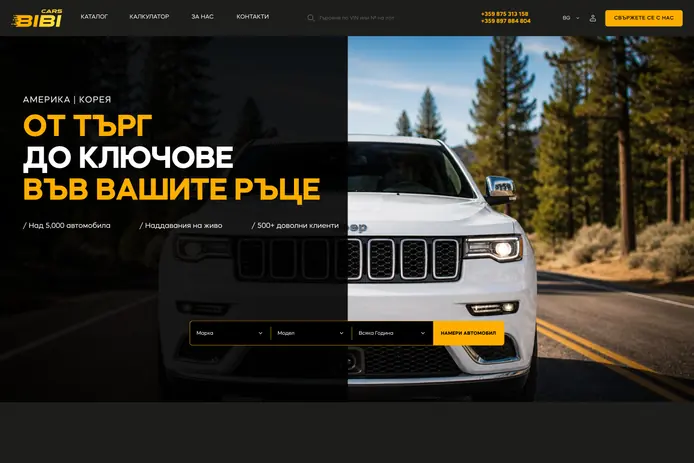
We built such a system for BIBI CARS, which brings used cars from auctions in the USA and South Korea to Bulgaria: a storefront that auction parsers keep filled, a deal CRM from the deposit to the keys, and four cabinets — admin, team lead, manager and client — on the same deal.

The same approach fits any importer or dealer: your stages, your documents, your markets, at a fixed price under a contract.

Case
BIBI CARSbibicars.bg / crm & storefront / 2026
Built
  • Storefront
  • Auction parsers
  • Deal CRM
  • Client cabinet
  • E-contracts and invoices
  • Shipment tracking
Format
AI + DEV
Price
Fixed after scoping, paid by stage

Problems

What slows a car import business down

  • Deals live in messengers and spreadsheets

    Every manager keeps their own version of the deal, and nobody sees the whole chain from the bid to the keys.

  • Clients call to ask where the car is

    Status questions eat the managers’ day. Without a cabinet, the only way for a client to follow a car is to ask a person.

  • A catalogue that goes stale

    Auction lots open and close every day. Copied by hand, the site shows sold cars and misses each car’s history.

  • Money that moves without documents

    A deposit without a contract, a payment without an invoice: when the stages are not enforced, disputes follow.

What we build

What we build for importers and dealers

  • Deal pipeline

    Deposit, bid, contract, payment, ocean and land shipping, customs and handover as explicit stages with owners; nothing moves on without its document or payment.

  • Storefront with auction lots

    A catalogue with VIN and lot search, kept filled by parsers from the auction sources you work with, with each car’s VIN history attached.

  • Import cost calculator

    A buyer sees what a car will cost to bring in before the first call.

  • Client cabinet

    The client follows the car stage by stage, signs contracts and pays invoices online.

  • A cabinet for every role

    Admin, team lead, manager and client see the same deal at their own level of detail.

  • Tracking and documents

    Container tracking and VIN history arrive automatically; contracts and invoices are generated from the deal and signed inside the system.

Case

How we built it for BIBI CARS

Car import from US and Korean auctions, end to end

BIBI CARS brings used cars from auctions in the USA and South Korea to Bulgaria, from the bid to the keys. Managers worked from messengers and spreadsheets, and questions about status took up their day.

We made each deal a pipeline with explicit stages and owners, connected auction parsers, container tracking and VIN history, and gave the client a cabinet to sign contracts, pay invoices and follow the car without calling.

Three formats

Choose how we build it

The format decides who writes the code and how much engineering review goes into it — and with that, the price and the pace.

  • AI / build

    AI Build

    Fastest path · prototypes & internal tools

    AI generates the structure and most of the implementation. Engineers review integrations and the release. The lowest cost, for prototypes, internal tools and MVPs that test an idea.

  • AI / engOur pick here

    AI + DEV

    Recommended for most MVPs

    AI builds the scaffolding and the obvious parts. Engineers own the architecture, critical logic, integrations and full QA. Balanced pace and review, for customer-facing MVPs and B2B products.

  • full / eng

    DEV

    Maximum quality & control

    Senior developers own architecture and implementation end to end. AI is an internal tool for speed, never the final author. For production systems and regulated domains.

A CRM carries your money and your clients’ data, so we usually build it in AI + DEV, with engineers owning permissions, documents, payments and the parsers. A storefront on its own can go faster in AI Build.

FAQ

Questions we get asked

How much does a CRM for car import cost?

It depends on the stages, roles, parsers, documents and integrations, so we price it by module. The estimate gives a first figure in about 15 seconds, the team review confirms it, and the contract fixes it.

Can it pull cars from auction sites automatically?

Yes. Parsers read the auction sources you work with and keep the storefront filled, with each car’s VIN history attached. Which sources and how often is agreed at the team review, since each source has its own terms of access.

Does it work for a dealer, not only an importer?

Yes. The pipeline is built from your own stages: a dealer selling local stock needs fewer of them than an importer, and the cabinets and documents work the same way.

Can clients sign and pay online?

Yes. Contracts and invoices are generated from the deal, and the client signs and pays them in their cabinet, so the deal moves on as soon as the document is in place.

Can you move our deals from spreadsheets or an old CRM?

Yes. Data migration is a module in the estimate: we map the old fields to the new structure, import, and check the result with you before you switch over.

Who owns the system?

You do, once the contract is paid in full: the source code, the documentation and the data. There are no per-seat fees.