Industries · Fintech & investment platforms

Fractional investment platform development

A platform that sells shares of real assets has to earn trust three times over: that the asset is real, that ownership is recorded, and that the income actually arrives. Fractional investment platform development is mostly about that trust — and about keeping the operation behind it manageable for a small team.

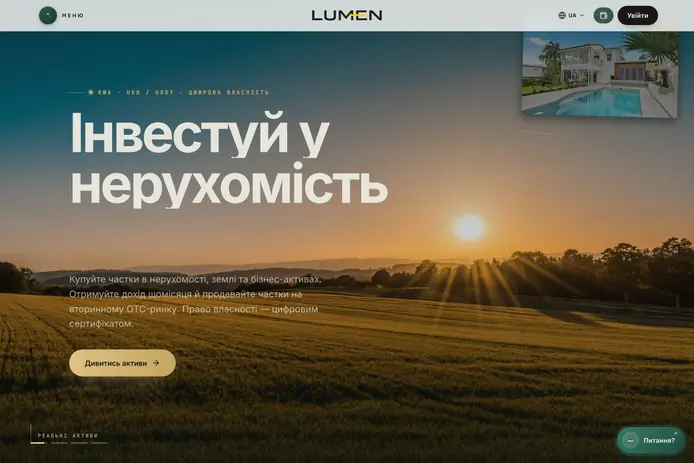
We built LUMEN, where people invest in a share of real estate, land or a business. Every share comes with an NFT certificate of ownership on chain, monthly income payouts and the option to resell it on an internal OTC marketplace. Investors use a mobile cabinet; the team runs assets, pools, KYC, payouts and risk on a web platform of about a hundred screens.

Whether you tokenise real-world assets (RWA) or run a classic co-investment platform, we build it at a fixed price under a contract, module by module.

Case
LUMENfintech / web3 / 2026
Built
  • Platform architecture
  • Smart contracts and NFT ownership
  • Investor app (Expo)
  • Staff platform
  • KYC
  • Payouts and risk engine
Format
DEV
Price
Fixed after scoping, paid by stage

Problems

What makes investment platforms hard to build

  • Trust has to be built into the product

    Investors need to see that the asset exists, that their share is recorded and that payouts arrive. A landing page can promise it; only the product can show it.

  • The back office outgrows the team

    Pools, KYC, payouts and partner settlements turn into spreadsheets and manual checks unless the platform runs them.

  • What goes on chain, what stays off

    Everything on a blockchain makes simple changes expensive; nothing on it gives up a public record of ownership. The line has to be drawn early.

  • Investors and staff need different products

    An investor wants a portfolio and the next payout on a phone; an operator needs a full set of controls. One interface for both serves neither.

What we build

What we build for fintech

  • Investor app

    A mobile cabinet with portfolio, income and wallet, built in React Native with Expo for iOS and Android.

  • Staff platform

    Assets, pools, KYC, payouts and risk on a web platform for the team, plus a mobile console for daily approvals.

  • Ownership on chain

    Smart contracts and NFT certificates as the register of ownership, while the economics stay on the platform.

  • KYC and onboarding

    Identity checks for every investor, built into sign-up and run by the team on the staff platform.

  • Payouts and risk engine

    Income payouts, pools and partner settlements on the backend, under a risk engine the team controls.

  • Secondary market

    An internal OTC marketplace where investors resell their shares to each other.

Case

How we built it for LUMEN

Fractional investment in real-world assets

LUMEN lets people invest in a share of a real asset instead of buying it whole. Co-investment needs trust on three levels, and the operation behind it — pools, compliance, payouts, partner settlements — had to stay manageable for a small team.

We split the product by audience: a full web platform for the team, a focused mobile cabinet for investors and a mobile console for daily approvals. Ownership is mirrored as NFTs on chain, while pools, payouts and settlements run on the backend under a risk engine.

Three formats

Choose how we build it

The format decides who writes the code and how much engineering review goes into it — and with that, the price and the pace.

  • AI / build

    AI Build

    Fastest path · prototypes & internal tools

    AI generates the structure and most of the implementation. Engineers review integrations and the release. The lowest cost, for prototypes, internal tools and MVPs that test an idea.

  • AI / eng

    AI + DEV

    Recommended for most MVPs

    AI builds the scaffolding and the obvious parts. Engineers own the architecture, critical logic, integrations and full QA. Balanced pace and review, for customer-facing MVPs and B2B products.

  • full / engOur pick here

    DEV

    Maximum quality & control

    Senior developers own architecture and implementation end to end. AI is an internal tool for speed, never the final author. For production systems and regulated domains.

A platform that holds investors’ money and identity data is a DEV job: senior engineers own the architecture, smart contracts, payouts and access rules, and AI is only an internal tool. A prototype to test demand with a few investors can start in AI + DEV.

FAQ

Questions we get asked

How much does a fractional investment platform cost?

It depends on the parts you need: investor app, staff platform, KYC, payouts, smart contracts, a secondary market. Each is a module in the estimate, which gives a first figure in about 15 seconds; the contract fixes the price after the team review.

Do we need a blockchain at all?

Not always. On LUMEN the blockchain is the register of ownership, while pools, payouts and settlements stay on the platform. If a public record of ownership does not matter to your investors, a regular database is simpler and cheaper; we decide it with you at the team review.

Do you handle licensing and the legal structure?

We build the software, not the legal structure. Licensing, securities rules and investor agreements are for your lawyers; we build the KYC, consents, records and reports they require.

Do you build both the mobile app and the web platform?

Yes. One team builds the investor app (React Native with Expo), the staff platform and the backend they share, so a payout the team approves is the same record the investor sees.

How do you handle security?

Access to every record is checked on the server, sensitive actions are logged, and money moves only through explicit states. For a platform like this we recommend the DEV format and a security pass before launch.

Who owns the code and the smart contracts?

You do, once the contract is paid in full: the source code, the smart contracts, the documentation and the data.