How to choose a software development company in Ukraine, step by step
Choosing a software development company in Ukraine comes down to the same questions as anywhere — can they build it, will they finish it, will you own it — plus two that are specific to the country: how the contract handles law and payments across borders, and how the team keeps working through power cuts and martial law. This guide walks through the selection in four steps: a shortlist, seven checks with a scorecard, a small paid trial and the decision.
On this page
- Decide what you are buying first
- The selection in four steps
- Step 1. Build a shortlist
- Step 2. Check seven criteria
- A scorecard for the shortlist
- Step 3. Test with a small paid piece of work
- Step 4. Decide and sign
- A two-week timeline
- Questions for clients outside Ukraine
- When to drop a candidate
- Where EVA-X fits
- Questions and answers
Decide what you are buying first
Ukrainian vendors fall into a few broad groups, and they sell different things:
- Large outsourcing companies sell teams: dedicated developers and managers billed by the hour or the month, often for years.
- Product studios sell results: a defined product — an MVP, a platform, an app — built and handed over, often at a fixed price.
- Freelancers sell individual skills, cheaply and flexibly, with the coordination left to you.
If you need ten engineers for three years, look at the first group. If you need a product built and launched, the second. If you need one specific task done and can manage it yourself, the third. The worst outcome is buying the wrong thing well: hiring a team when you needed a product, or a product studio when you needed a team. In-house team, studio or freelancers compares the options in depth.
The selection in four steps
- Shortlist three to five companies of the right type.
- Check each one against the same seven criteria and score them.
- Test the best one or two with a small paid piece of work, or with the first module of a contract that is paid and accepted module by module.
- Decide after reading the draft contract and talking to a reference client.
The steps are simple. The discipline is in doing them in order, with the same brief for every candidate.
Step 1. Build a shortlist
Start with one page that describes the product: who uses it, what they do in it, which systems it connects to, your budget range and when you need it. Send the same text to every candidate, so the answers can be compared.
Where to find candidates:
- Referrals from people who have shipped a similar product and would hire the same team again.
- Products you admire in your niche: find out who built them, then look for them on the studios’ case pages.
- Case pages that name the product, the year and what exactly was built, with a link to the live product.
- Directories and review sites, as a starting point only: check every claim you find there yourself.
Three to five candidates is enough. With more, the time goes into calls rather than into reading the answers carefully.
Step 2. Check seven criteria
1. Live work you can open yourself
Ask for links to products that are live today, not just screenshots. Open them, sign up if you can, download the app. Then ask what exactly the company built: the whole product, or one part of it? Case pages that name the product, the year and the services delivered are a good sign, and so is a client you can talk to.
2. Who will actually write the code
Ask who will be on your project and in which roles. Is the team the company’s own, or will the work be passed to subcontractors? How much of the code will be generated by AI, and who reviews it? None of these questions has a single right answer, but you should get a clear one. Ask about experience too: who on the team has built something similar, and who is responsible for the architecture.
3. How they arrive at a price
A serious vendor asks questions before giving a number. Ask for the estimate broken into modules or tasks with hours, and for the list of what is excluded. Ask whether the price is fixed or an hourly forecast, and how changes are handled. If two vendors give very different numbers, ask each to explain what they included; the difference often comes down to scope rather than rates.
4. The contract
Read it before you fall in love with the demo. Look for:
- Governing law and jurisdiction. Ukrainian law and Kyiv courts are common for Ukrainian vendors; some work under another law for foreign clients. Know which one applies and whether it suits you.
- Intellectual property. The contract should transfer the economic rights to the code, designs and documentation to you, in writing, and say when — usually on payment. Don’t assume the rights pass automatically because you paid.
- Acceptance and warranty. How you review work, how long you have, what counts as a defect, and for how long defects are fixed free of charge.
- Confidentiality and non-solicitation. Standard clauses, but read the terms.
- Termination and refunds. What happens to the money and to work in progress if either side stops.
5. Payments and what protects you
Avoid paying everything upfront. Payment by stages, tied to delivered and accepted work, keeps both sides honest. Ask where your prepayment sits until the work is accepted, how you can see it, and what happens to it if the project stops. It is a good sign when a vendor shows you, unprompted, how much you have paid, how much has been applied to accepted work and how much is still waiting.
6. Communication and time zone
Kyiv is on Eastern European Time (UTC+2, UTC+3 in summer), so the working day overlaps almost entirely with continental Europe and with the morning on the US East Coast. Ask how you will see progress — a cabinet, a board, demos — how often, and who your single point of contact is. Then test it during the sales process: how quickly and how clearly do they answer? Ask which language the documentation and tasks are kept in; it matters if another team maintains the product later.
7. Continuity: power, connectivity and martial law
Ask this directly; a vendor who has thought about it will have a concrete answer. What happens to the work during a power cut or an air-raid alert? Do people have backup power and connectivity? Is the team distributed, so that one district’s outage does not stop the project? Then read the force majeure clause. Ukrainian contracts often adapt it to martial law, and you should know how delays caused by the war are handled and what happens to deadlines and payments. Finally, know where the code lives and when you get access to the repository, so that the project could continue with another team if it ever had to.
A good answer sounds like this: generators or portable power stations, backup internet, an agreement on who picks up the work when someone is offline. A vague “we’re fine” is a reason to ask again.
A scorecard for the shortlist
| Criterion | What to ask | A good answer looks like |
|---|---|---|
| Proof | Which live products did you build, and which parts of them? | Links, years, named services, a reference |
| Team | Who works on my project? | Names or roles, their own team, a clear AI policy |
| Price | How did you get this number? | Modules with hours, exclusions, and whether it is fixed or hourly |
| Contract | Which law, which IP terms, which acceptance rules? | A draft contract you can read before paying |
| Payments | What do I pay before work is accepted? | Staged payments tied to accepted work |
| Visibility | How will I see progress? | A cabinet or board, regular demos, one contact |
| Continuity | What happens during outages? | Concrete backups, a distributed team, a clear force majeure clause |
| After launch | What does the warranty cover? | A defined period and a definition of a defect |
Score each vendor from one to three on every line. The total matters less than the lines where someone scores a one. The questions to put behind each line are collected in questions to ask a software development company before you sign.
Step 3. Test with a small paid piece of work
Calls and documents show how a company sells; a small paid piece of work shows how it builds. Before a large contract, consider buying one of these from your top one or two candidates:
- A paid scoping phase. The company turns your brief into a list of modules with acceptance criteria and a price. You keep the document whoever you hire.
- A clickable prototype of the main flow, if the main risk is in the user experience.
- The first module of the real product, with its own price, deadline and acceptance.
Keep the trial short — one to three weeks — and at a fixed price, so it tests the team rather than your patience. While it runs, watch for:
- Not checked: the questions they ask before starting, and whether they write down what was agreed;
- Not checked: whether they deliver on the date they named, or warn you early when they can’t;
- Not checked: how they report progress without being chased;
- Not checked: what you can open and check yourself: a build, a link, a repository branch;
- Not checked: how they handle your review: fixes for what was agreed, a price for what was not.
Make sure the agreement for the trial says that what you paid for is yours: the scoping document, the prototype or the code of the module.
If the main contract already splits the product into modules that are paid for and accepted one at a time, you may not need a separate trial. The first module plays that role, and if it goes badly you have a natural exit point.
Step 4. Decide and sign
Read the draft contracts of your top two line by line, against criteria 4 and 5. Talk to a reference client of each and ask what went wrong on their project and how the company handled it; something goes wrong on every project, and the handling is what you are buying. Then decide, and write down why you chose this company. You will want those reasons when you look back at the decision after the first modules.
A two-week timeline
- Days 1–2. Write the one-page brief and send it to three to five vendors.
- Days 3–7. First calls. Write down the questions each vendor asks you; they show who understood the product.
- Days 8–10. Compare the estimates line by line against the scorecard. Ask about every module that one vendor priced and another left out.
- Days 11–14. Read the draft contracts of the top two, talk to a reference client of each, and decide — or start a paid trial with one of them.
Give yourself a deadline like this one: two weeks is a sensible target for choosing a team for one product, plus the length of the trial if you run one. If the selection drags on for months, look at the brief first. When the brief is vague, every vendor answers a different question, and nothing can be compared.
Questions for clients outside Ukraine
If you are hiring from abroad, add three questions for your own lawyer or accountant (this is not legal advice):
- Who signs. Ukrainian vendors work as limited liability companies — some of them residents of Diia.City, Ukraine’s special legal and tax regime for IT companies — or as private entrepreneurs. Check which entity is named on your contract and invoices.
- Currency. Contracts with foreign clients are often priced in US dollars or euros and paid by bank transfer or by card through a payment provider.
- Taxes. Services bought from a Ukrainian company may have VAT or withholding consequences in your country. Ask before you sign, not when the first invoice arrives.
More on contracts, payments and working hours for clients abroad in outsourcing software development to Ukraine.
When to drop a candidate
Some answers should end the conversation early: a price given without a single question about your product, 100% payment upfront, no contract or a contract without IP transfer, acceptance and a warranty, and nobody who can tell you who will write the code. One warning sign is a reason to ask more questions; two or three are a reason to move on, however good the price looks. The full list, with what each sign tends to mean, is in red flags when hiring a software development agency.
Where EVA-X fits
We are a product studio in Kyiv. Our own team builds web platforms, mobile apps, CRMs, marketplaces and AI features, and we don’t resell projects to subcontractors. You describe the product, the estimate shows modules, hours, a timeline and a price in about 15 seconds, and our team reviews the scope with you before a contract signed online fixes the scope, the price and the payment schedule. Payments are held in the project reserve and released module by module as you accept the work, so the first accepted module is your first real check of how we work. The rights to the code pass to you once the contract is paid in full.
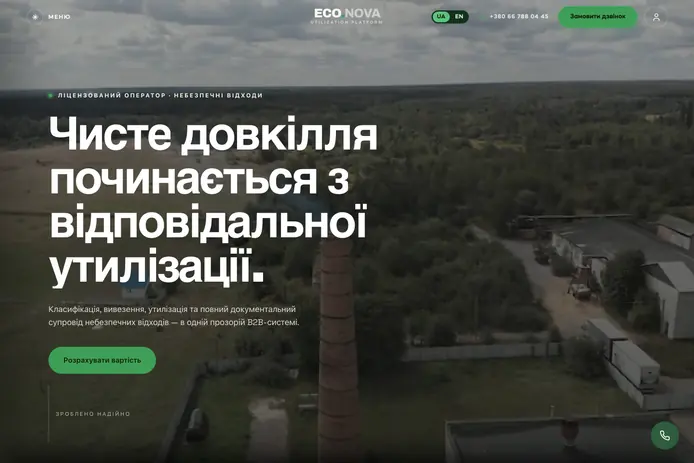
Our case pages show what we built for each client — for example BIBI CARS, which imports used cars from auctions in the USA and South Korea to Bulgaria, and ECO.NOVA, a licensed hazardous waste operator. If you need a large dedicated team for years of hourly work, a bigger outsourcing company may suit you better, and we would rather say so up front. More on how we work: custom software development.
Questions and answers
How do I choose a software development company in Ukraine?
Decide whether you need a team or a finished product, then shortlist three to five companies and send them the same brief. Check live work you can open, who will write the code, how the price was built, the contract terms on IP, acceptance and warranty, staged payments, communication and continuity during outages. Test the best candidate with a small paid piece of work or the first module, then decide.
Is it safe to outsource software development to Ukraine now?
The risk is real and should be managed, not assumed away. Ask about backup power and connectivity, how the team is distributed and what the force majeure clause says; pay by stages tied to accepted work; and make sure you know where the code lives and when you get access to it.
Should I pay for a trial before signing the main contract?
For a large project, it is worth it. A paid scoping phase, a prototype or the first module shows how a team works far better than calls do. Keep it short and at a fixed price, and make sure what you paid for is yours. If the main contract is paid and accepted module by module, the first module can play the role of the trial.
How much do software developers in Ukraine cost?
Rates vary widely with seniority, technology and the type of company, and rates alone don’t tell you what a product will cost. Compare fixed quotes for the same scope, or hourly estimates plus a realistic overrun, rather than rate cards.
Who owns the code when a Ukrainian company builds it?
Whoever the contract says. Make sure it transfers the economic rights to the code, designs and documentation to you — usually on full payment, or module by module — and covers the territory and the term. Don’t rely on the assumption that paying for the work makes it yours automatically.
Can I sign a contract with a Ukrainian company online?
Yes. Ukrainian law recognises contracts made and signed electronically, and studios sign them through their own platform or an e-signature service. At EVA-X, for example, you review the contract in your cabinet and sign it with a one-time code sent to your email, and the studio signs at the same moment.
What should I ask on the first call?
Which live products they built and which parts of them, who will work on your project, how they will arrive at a price, what the contract says about IP and acceptance, how payments are staged, how you will see progress and what happens during outages. Pay attention to their questions as well: a vendor who asks nothing has not understood your product.
// We build this
Custom software development
Platforms, apps and internal systems built for how your business works, for a price fixed before work starts.
About the service →Describe the product. Get a fixed price.
Text, a link or a file is enough. The estimate takes about 15 seconds and costs nothing; our team reviews it before any contract.
Get a fixed price