Services
Web application development
Most of the products we build live in a browser: client cabinets, B2B platforms, SaaS tools, dashboards with roles and permissions. As a web application development company, we take one from a brief to production — interface, backend, database, integrations, hosting — for a price fixed in the contract.
A web app is never just screens. Behind a B2B company’s site there is often a system where every order carries its documents and a private file opens only for its owner; behind a storefront, a CRM that runs each deal through a dozen stages. That part — access, data, the logic between roles — is where our engineering goes.
We build the public side too: fast company and brand sites with service pages, SEO and request forms that lead somewhere.
- Price
- Fixed after scoping
- Payments
- By stage, held until you accept
- Team
- Our own engineers, Kyiv
- Contract
- Signed online, scope locked
Web application development
What we build
Client portals and cabinets
Orders, documents, payments and statuses in one place, so clients stop calling to ask.
B2B platforms
Systems for clients, managers and partners, where each role sees the same data from its own side.
SaaS products
Accounts, subscriptions or invoices, onboarding, an admin and the settings customers expect.
Dashboards and analytics
Live data from your sources, filtered and charted for the decisions people actually make.
Company and brand sites
Pages that load fast and rank, with motion where it helps and forms connected to your sales.
Security by default
Strict sessions, owner checks on every file and record, safe uploads and a log of sensitive actions.
How it works
From a brief to an accepted product
The same five steps for every project, whatever we build. You always know what is agreed, what is paid and what is done.
Estimate
Describe the product in your own words, add a link or a file. In about 15 seconds you see the modules, the hours, the timeline and a price.
Team review
Our team reads the brief and the estimate, asks about anything unclear in your cabinet or on a call, and confirms the scope and the price. Nothing starts before that.
Contract
You sign a contract online: a fixed price, the scope split into modules, and a payment schedule — in full or by stages.
Milestones
We build module by module. QA checks each one before it reaches you, and the cabinet shows the work as it moves.
Acceptance
You have 7 days to review each module: accept it or send it back with a list of fixes. Your money stays in the project reserve until you accept.
Three formats
Choose how we build it
The format decides who writes the code and how much engineering review goes into it — and with that, the price and the pace.
- AI / build
AI Build
Fastest path · prototypes & internal tools
AI generates the structure and most of the implementation. Engineers review integrations and the release. The lowest cost, for prototypes, internal tools and MVPs that test an idea.
- AI / engOur pick here
AI + DEV
Recommended for most MVPs
AI builds the scaffolding and the obvious parts. Engineers own the architecture, critical logic, integrations and full QA. Balanced pace and review, for customer-facing MVPs and B2B products.
- full / eng
DEV
Maximum quality & control
Senior developers own architecture and implementation end to end. AI is an internal tool for speed, never the final author. For production systems and regulated domains.
Client-facing web apps usually go AI + DEV: engineers own access rules, data and integrations, and AI takes the repetitive screens. Internal dashboards are a good fit for AI Build. Platforms that handle payments, personal data or regulated documents deserve DEV.
Cases
Work that proves it
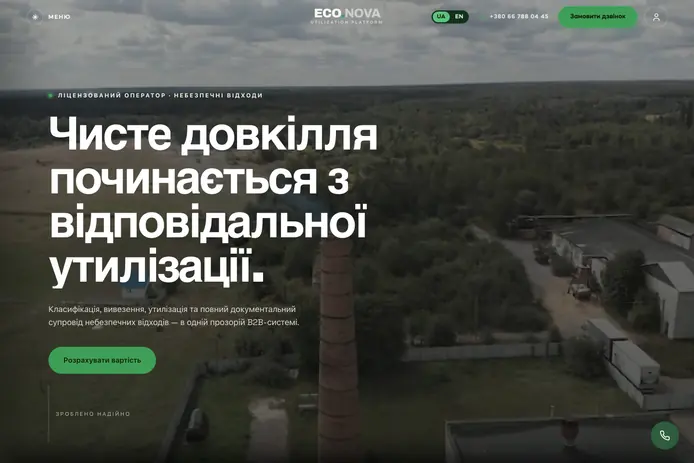 ECO.NOVAb2b / operations platform / 2026
Hazardous waste disposal as a transparent B2B service
Read the case → BIBI CARSbibicars.bg / crm & storefront / 2026
Car import from US and Korean auctions, end to end
Read the case → TAMIS AGROtamisagro.com.ua / agro e-commerce / 2026
An online store for biological crop protection
Read the case →FAQ
Questions we get asked
How much does a web application cost?
A web app is priced by its modules: roles, screens, integrations, the admin. The estimate gives a first price in about 15 seconds; after the team review it is fixed in the contract and does not grow with the hours.
Website or web application — which do I need?
A website tells people about your company; a web application does work for them — takes orders, calculates, stores documents, shows each user their own data. Many businesses need both, and we build both, so requests from the site land straight in the system.
Which technologies do you use?
Usually React and Next.js for the interface, Python or Node.js for the backend and PostgreSQL or MongoDB for the data; for mobile, React Native with Expo. Unless the contract fixes the stack, we choose it for the project and explain why.
How do you handle security?
Access to every record and file is checked on the server, sessions are strict, uploads are validated and sensitive actions are logged. For platforms with money or personal data we recommend the DEV format and a security pass before launch.
Will I see the work before it’s finished?
Yes. Each module arrives in your cabinet for review — as a link or a test build — with a note on what was done and how to check it. You have 7 days to accept it or send it back with a list of fixes.
Who owns the code and the data?
Your data is yours from the start. The rights to the code pass to you once the contract is paid in full (or module by module, if the contract says so), together with the source code and documentation.
Services
Related services
- CRM and internal systemsDeal pipelines, documents, client cabinets and reports, built around the process your team actually runs.
- E-commerce developmentCustom online stores and B2B e-commerce with catalogues, calculators and accounts that sell like an expert.
- Custom software developmentPlatforms, apps and internal systems built for how your business works, for a price fixed before work starts.