Custom CRM development cost in 2026: ranges, drivers and a phased budget
Custom CRM development cost starts around $10,000 for a pipeline one team can work in and runs to $80,000–$200,000 and more for an operations system with documents, client cabinets, parsers and integrations. Where your CRM lands depends on your process, not on a feature list: how many stages a deal goes through, who touches it, which documents and payments gate each step, and which systems feed it data. Here is how to estimate it, how to check it against a subscription and how to spread it over phases.
On this page
- First: should you build at all?
- Typical ranges in 2026
- What moves the price
- An example from our work: BIBI CARS
- A cost check against a subscription: three years, not the first invoice
- Build it in phases
- Where CRM budgets go wrong
- Hidden costs to plan for
- A one-page brief for a CRM quote
- How we price a CRM
- Questions and answers
First: should you build at all?
Buy when your process fits a standard tool. A sales team with a classic funnel — lead, call, proposal, deal — is well served by off-the-shelf CRMs, and building one would be money spent on reinventing them. Build when the process stops fitting the fields: when a deal cannot move without a document or a payment, when clients need their own cabinet, when the data comes from sources no standard CRM reads, or when the team already keeps the real pipeline in spreadsheets and messengers because the CRM gets in the way. The full decision is in custom CRM or off-the-shelf.
Typical ranges in 2026
An orientation for quotes from studios in Ukraine and Eastern Europe, not a price list; your process decides where you land, and the estimate prices it module by module:
| Type | What is inside | Typical range | Typical timeline |
|---|---|---|---|
| Pipeline for one team | Contacts, deals, your stages, tasks, simple reports, import from spreadsheets | $10,000–$30,000 | 3–6 weeks |
| CRM with documents and a client cabinet | Several roles, generated contracts and invoices, e-signatures, client access, notifications | $30,000–$80,000 | 2–4 months |
| Operations system | CRM plus parsers or feeds, finance, logistics or production stages, several cabinets, an audit trail | $80,000–$200,000+ | 4–8 months |
What moves the price
| Driver | The question to answer | Why it costs |
|---|---|---|
| Stages and rules | How many stages, and what must be true before a deal moves on? | Every gate is logic plus tests |
| Roles | Who works in the system, and what may each role see and change? | Permissions on every record and action |
| Documents | Which contracts, invoices and acts are generated, and who signs them? | Templates, numbering, versions, e-signature |
| Integrations | Telephony, email, messengers, website forms, accounting, external data? | Each has its own API, limits and failure modes |
| Data migration | What moves from spreadsheets or the old CRM, and how clean is it? | Mapping, cleaning, test imports, sign-off |
| Client cabinet | Do clients follow their order, sign and pay online? | A second product with its own design and security |
| Reports | Which numbers do managers and owners decide on? | Correct data across stages, fast queries |
| Audit | Do you need a trail of who changed what? | Logging and a way to read it |
Three drivers deserve emphasis, because they are easy to underestimate.
Integrations. “Connect our telephony” can mean logging calls against a contact — a small task — or click-to-call, recordings and call analytics inside the deal card, which is a module. Write down exactly what should happen in the CRM when a call, an email or a form submission arrives.
Migration. Old data is usually messier than its owners expect: duplicates, contacts without phone numbers, deals in three spellings of the same stage. Migration is a module in its own right. Skip it, and the team starts in an empty system and keeps the old one open “for reference” forever.
Client cabinet. Giving clients access turns an internal tool into a product other people judge you by. It needs its own design, careful permissions — a client must never see another client’s deal — and notifications that say what changed without flooding anyone. It can also be the module that pays back fastest, because it removes the calls asking where things are.
An example from our work: BIBI CARS
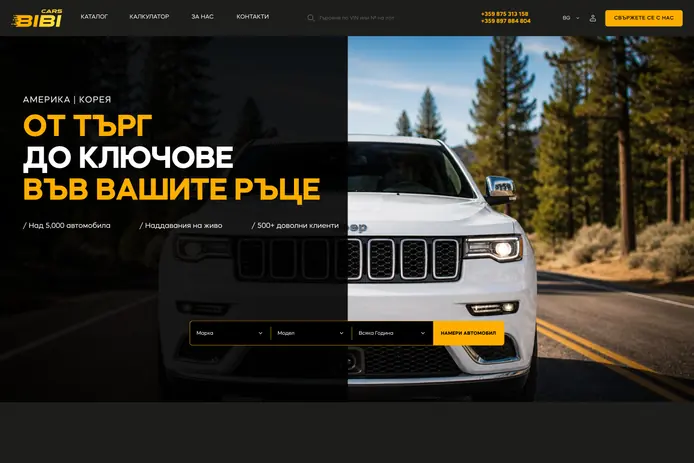
BIBI CARS imports used cars from auctions in the USA and South Korea to Bulgaria. Before the system, managers worked from messengers and spreadsheets, and questions about status took up their day. We built a storefront with VIN and lot search and an import cost calculator, parsers that keep the catalogue filled from auction sources, and a CRM that runs every deal through its stages: deposit, bid, contract, payment, ocean and land shipping, customs and handover. Four cabinets — admin, team lead, manager and client — see the same deal at their own level of detail. Contracts are signed and invoices paid inside the client cabinet; container tracking and VIN history arrive automatically.
The lesson for budgeting: the screens are the smaller part. The cost lives in the rules — nothing moves without a document or a payment behind it — and in the integrations that bring data in without anyone copying it by hand. What an import business needs from its CRM, stage by stage, is in car import CRM.
A cost check against a subscription: three years, not the first invoice
A subscription CRM is cheap to start and charges per user, every month, for as long as you use it; advanced plans and add-ons cost more. A custom CRM costs more upfront, then hosting and support, with no per-seat fees and no licence to renew. To compare them fairly, put both on the same three-year horizon:
- Subscription: users × monthly price per user × 36, plus paid add-ons, plus setup or integrator fees, plus the cost of workarounds where the tool does not fit.
- Custom: the build, plus hosting and third-party services for 36 months, plus support and changes.
A hypothetical to make it concrete: 25 users on a plan at $50 per user per month cost $45,000 over three years before any add-ons. If your process needs a custom system anyway, that money belongs in the comparison. If a standard plan fits with little customisation, the subscription will usually win — and you should take it.
Also count what appears on neither invoice: the hours managers spend on double entry when the tool does not fit, and the deals that slip because a stage lives in someone’s messenger. Cost is only one side of the choice; fit, control and risk are weighed in custom CRM vs off-the-shelf.
Build it in phases
A CRM does not have to arrive in one piece. A phased plan lets the team start working while the rest is built:
- Pipeline: contacts, deals, your stages and their rules, tasks, import of existing data.
- Documents and payments: generated contracts and invoices, e-signatures, payment statuses tied to stages.
- Client cabinet: clients follow their orders, sign and pay without calling a manager.
- Integrations and reports: telephony, email, external data, the numbers owners decide on.
Mapped onto the table, phase one alone is a pipeline for one team, the $10,000–$30,000 band. Phases two and three turn it into a CRM with documents and a client cabinet, the $30,000–$80,000 band, and parsers, finance or logistics stages on top are where an operations system begins. Phasing does not make the total smaller by itself, but each payment buys a part the team already uses, and after any phase you can stop, reorder or change course.
Each phase is a module with its own acceptance, so adoption problems show up in week three, not in month six. Ideas for later phases are in AI in CRM: practical use cases and automating business processes.
Where CRM budgets go wrong
- Building every wish. Each manager has a favourite field and a favourite report. Collect the wishes, then keep only those tied to a stage, a document or a decision.
- Copying the old system. A migration is a chance to drop the fields nobody fills in and the stages nobody uses. Rebuilding the old CRM in new code repeats its problems at a higher price.
- Starting with dashboards. Reports are only as good as the data behind them. Build the pipeline first, let the data accumulate, then chart what people actually ask about.
- No owner. A CRM without one person who decides what changes drifts into a mess of exceptions. Name that person before the build starts.
Hidden costs to plan for
- Adoption. Training, a week or two of running old and new side by side, and one person inside the team who owns the system.
- Data quality. Cleaning before migration, and rules that keep the data clean afterwards.
- Third-party fees. E-signature, telephony, SMS, AI models — each with its own tariff.
- Change. Your process will change once the system shows you where it leaks. Keep budget for that.
A one-page brief for a CRM quote
- The stages a deal goes through today, including the unofficial ones
- Who works with a deal at each stage, and who approves what
- The documents and payments each stage needs
- Where the data comes from: forms, calls, email, marketplaces, accounting
- What clients should see and do themselves
- How much data you have now, and where it lives
- The three numbers the owner checks every week
How we price a CRM
Describe how a deal moves today — stages, people, documents, the systems involved — in text, a file or a voice message, and the estimate turns it into modules with hours, a timeline and a price in about 15 seconds. The estimate is free and non-binding; our team reviews it with you and checks the process before the contract fixes the price. We usually build CRMs in AI + DEV, with engineers owning permissions, documents and integrations, and in DEV for regulated processes such as finance or hazardous goods. Once the contract is paid in full, the source code and documentation are yours, the data has been yours all along, and there is no licence to renew. More on what we build: custom CRM development.
Questions and answers
How much does a custom CRM cost?
As an orientation for 2026: a pipeline for one team, roughly $10,000–$30,000; a CRM with documents, e-signatures and a client cabinet, $30,000–$80,000; an operations system with parsers, finance and several cabinets, $80,000–$200,000 and more. The price follows your stages, roles, documents and integrations, so a module-by-module estimate is more useful than any average.
Is a custom CRM cheaper than Salesforce or HubSpot in the long run?
Sometimes. Compare three years of per-user subscriptions, paid add-ons and setup with the build plus hosting and support. For a small team whose process fits a standard tool, the subscription usually wins. For a larger team with a non-standard process, documents and client access, a system you own can cost less and fit better.
How long does it take to build a CRM?
A pipeline for one team typically takes three to six weeks; a CRM with documents and a client cabinet, two to four months; an operations system, longer. Building in phases means the team can start working with the first phase while documents, cabinets and integrations are still being built. At EVA-X the timeline starts once the contract is signed and the first payment arrives.
Can you migrate data from spreadsheets or our old CRM?
Yes. Migration is priced as its own module: we map the old fields to the new structure, clean out duplicates, run a test import and check the result with you before you switch over. Expect the cleaning to take longer than the import itself; old data is rarely as tidy as it looks.
What does a custom CRM cost to run?
Hosting and backups, third-party services such as e-signature, telephony, SMS or AI models, and support for changes. There are no per-seat fees and no licence, so the running cost does not grow with every manager you hire. Ask for the running costs as a separate list before you sign anything.
Who owns a custom CRM?
You should. At EVA-X the rights to the source code and documentation pass to you once the contract is paid in full, or module by module if the contract says so, and your data is yours from the start. Whoever builds your CRM, make sure the contract says the same in writing.
// We build this
CRM and internal systems
Deal pipelines, documents, client cabinets and reports, built around the process your team actually runs.
About the service →Software development cost calculator →Describe the product. Get a fixed price.
Text, a link or a file is enough. The estimate takes about 15 seconds and costs nothing; our team reviews it before any contract.
Get a fixed price